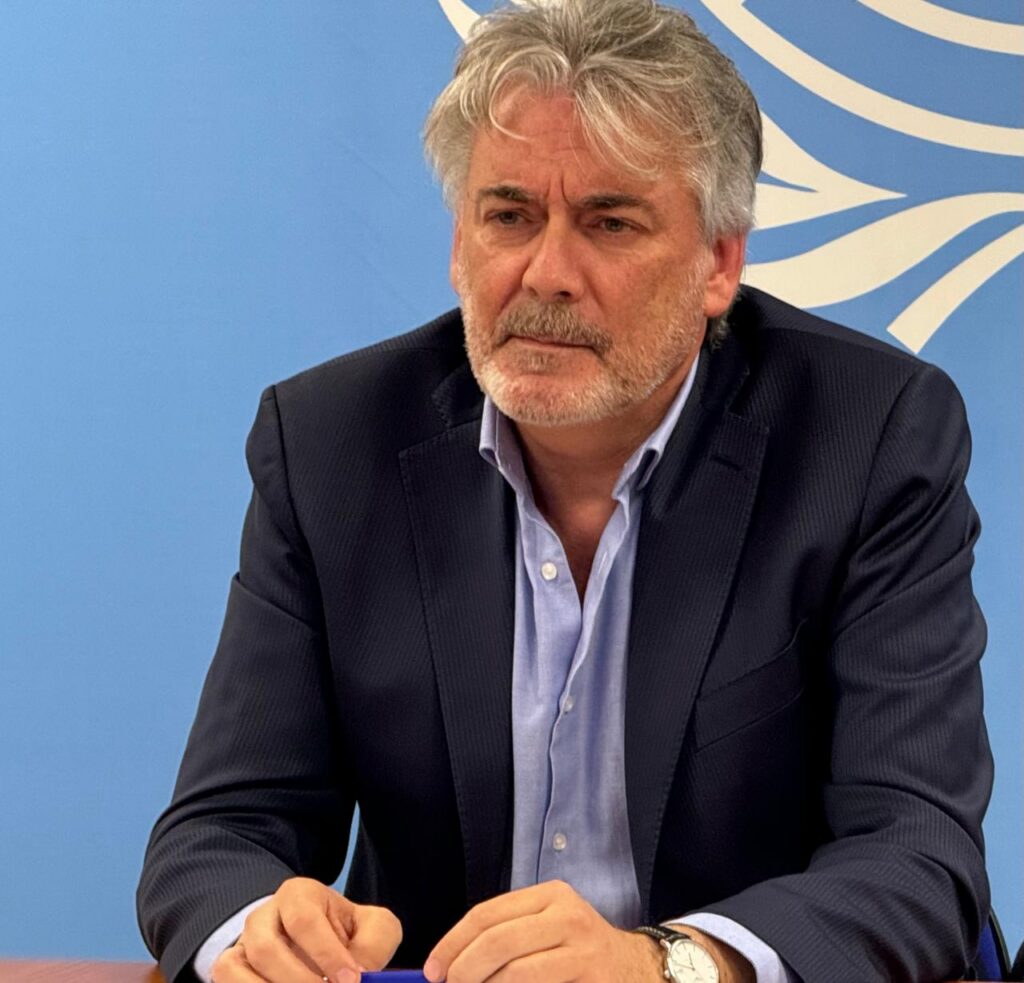
Andrea Tenenti
Andrea Tenenti: “At present, I see little evidence of a fundamentally different political concept capable of replacing Resolution 1701”
Andrea Tenenti: The strategic objective should be to accelerate the Lebanese Army’s ability to assume full responsibility for security throughout southern Lebanon
Andrea Tenenti: Israel Is Pushing for a Vacuum in the South, While Supporting the Lebanese Army Could Be an Alternative to Establishing Another International Presence
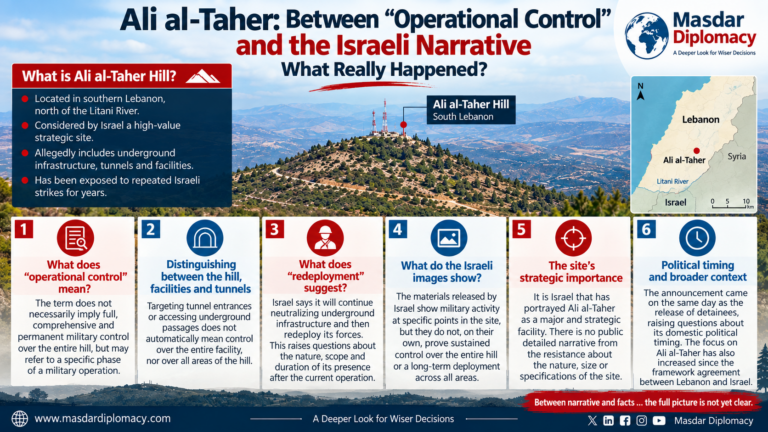
Andrea Tenenti: Ali Al-Taher Is More of an Israeli Propaganda Tool Ahead of the Elections Than a Strategic Point
“Masdar Diplomacy”
Interview by Marlene Khalifeh
Amid the intensifying debate in international and diplomatic circles over the future of UNIFIL and whether it can be replaced by another international mechanism, this interview with Andrea Tenenti, former UNIFIL spokesperson and Head of Strategic Communications, comes at a highly sensitive time, following the Security Council’s decision on 28 August 2025 to extend the force’s mandate for the last time until the end of December 2026, with its orderly and safe withdrawal to begin over the course of 2027. The decision brings back to the forefront questions about the post-UNIFIL phase and the risks of a vacuum that could emerge in the south.
In this interview, Tenenti argues that the fundamental problem does not lie in Resolution 1701 itself, but rather in the political failure to implement it, and warns that any future international presence will not be effective without international legitimacy, political backing, security guarantees and clearly defined rules of engagement. He also reveals that a number of countries have expressed their willingness to assist in the pilot areas, but that the concerns are less about who is willing to help than about the mandate under which they would operate and the guarantees that would enable them to operate effectively, warning that introducing any international presence amid a political and operational vacuum could put its credibility and effectiveness at risk from the outset.
Tenenti addresses the case of Ali Al-Taher, considering him “an Israeli propaganda tool before the election more than a strategic point,” while placing the Lebanese Army at the heart of the next phase, stressing the need for it to assume full responsibility for all areas of the south, with genuine support from the international community, and emphasizing that Resolution 1701, despite the absence of consensus, remains the most realistic framework for moving forward.
Andrea Tenenti, former spokesperson for the United Nations Interim Force in Lebanon (UNIFIL) and Head of Strategic Communications, is one of the most experienced international voices on the issue of southern Lebanon and Resolution 1701. He spent nearly two decades in Lebanon, arriving in October 2006, directly after the war between Israel and Lebanon, and during these years witnessed the major transformations that affected the UNIFIL mission and the security and political landscape on both sides of the Blue Line.
Throughout his long career, which extended for nearly 19 years with UNIFIL and during which he worked under eight Force Commanders, Tenenti was in a position that enabled him to closely follow the details of the mission’s work and the related field and political developments, and to speak on its behalf in one of the world’s most sensitive peacekeeping environments.
On 27 August 2025, on the eve of the Security Council’s decision on the future of UNIFIL, Tenenti was still officially speaking on behalf of the mission, at a time when the force’s mandate was before the Council amid intense international debate over its future. The following day, 28 August, the Security Council unanimously adopted Resolution 2790, which extended UNIFIL’s mandate for the last time until 31 December 2026, after which a process of gradual reduction and an orderly and safe withdrawal of its personnel would begin over the course of a year.
Tenenti left Lebanon after the end of his mission, but his testimony has particular significance at this stage, not only because he spent many years at the heart of UNIFIL’s work, but also because he was among the voices that followed the debate over its future until the moment the Security Council took its final decision regarding its mandate.
In this interview with “Masdar Diplomacy,” Tenenti discusses the future of Resolution 1701 in light of the new decision, and examines whether the problem lies in the resolution itself or in the political failure to implement it, and whether replacing it with a new framework could offer a different solution. He also addresses the conditions required for any future international presence in the south, the risks of a vacuum, and the role that the Lebanese Army should play in the next phase.
The interview also addresses the issue of the pilot areas, the country that may participate in verifying them, and the framework agreement reached in Washington between Lebanon and Israel, as well as developments related to Ali Al-Taher and Hezbollah’s weapons, and the future of the international presence in southern Lebanon.
The importance of this interview also stems from the fact that Tenenti speaks in it after the end of his official mission, and from a different professional position that allows him to assess the future of UNIFIL, Resolution 1701 and the international presence in the south in light of the developments that the issue has witnessed during the years he spent in Lebanon.
Marlene Khalifeh: Do you think the problem lies with Resolution 1701 itself, or with the political failure to implement it?
Andrea Tenenti: The debate over whether to repeal, replace or substantially modify UN Security Council Resolution 1701 needs to begin with a fundamental question: is the problem the resolution itself, or the political failure to implement it? In my view, the latter remains the central issue.
Marlene Khalifeh: What would be the political and operational difficulties of replacing Resolution 1701 with a new framework?
Andrea Tenenti: Replacing Resolution 1701 would be politically and operationally difficult. Any new framework would require the approval of all 15 members of the Security Council, while the five permanent members, and particularly the United States would inevitably shape its principal benchmarks and political parameters. The strong positions taken by the US, combined with sustained Israeli pressure, could significantly influence the outcome.
This creates an immediate dilemma for any future international presence. Countries willing to support the Lebanese government, strengthen the Lebanese Armed Forces (LAF), prevent a renewed conflict (still ongoing) and contribute to stability in southern Lebanon cannot realistically operate independently. Whether the framework is provided by the UN, the European Union or another international arrangement, such efforts would require formal international legitimacy, political backing and clearly defined rules of engagement. Without these, the credibility and ultimately the effectiveness of any international deployment would be severely constrained.
Marlene Khalifeh: Does Resolution 1701 already contain the essential elements needed to address the situation, and has its main weakness been the failure of the parties to fully implement their obligations?
Andrea Tenenti: Resolution 1701 already contains many of the essential elements required to address the situation. Its fundamental weakness has not been the absence of an adequate framework, but the failure of the parties to the conflict to fully implement their obligations. The international community has repeatedly attempted to manage the consequences of violations rather than address their political causes. The various understandings and cessation-of-hostilities arrangements reached over the years, including the most recent framework negotiated in Washington, have similarly depended on the willingness of the parties to comply.
Marlene Khalifeh: How do Israel’s continued military actions and its reliance on perceived security threats affect the ability of a peacekeeping mission to operate effectively?
Andrea Tenenti: The continuing Israeli military destruction in southern Lebanon with thousands of people being killed, illustrates the difficulty. Israel has consistently justified violations and military action on the basis of perceived security threats. Yet the distinction between a demonstrable and independently verified threat and a threat based primarily on one party’s assessment is critical. A peacekeeping mission cannot credibly substitute its own political judgment for that of the parties, but neither can a peacekeeping presence be expected to function effectively when one side’s unilateral security perceptions become sufficient justification for continued military action.
For this reason, any future international mission, whether under the UN, EU or another multilateral structure will require more than a new mandate. It will need credible security guarantees, political backing from the international community, clarity regarding its role and responsibilities, and, above all, a genuine commitment by the parties to stop the cycle of violence. Without these minimum conditions, changing the institutional label of the international presence will not change the underlying reality. Credibility and effectiveness are key to any future international presence.
Marlene Khalifeh: What political conditions would determine whether a fundamentally different framework could realistically replace Resolution 1701?
Andrea Tenenti: At present, I see little evidence of a fundamentally different political concept capable of replacing 1701. Nor is there sufficient evidence that the parties would necessarily comply more effectively with a new resolution simply because it carried a different name. Elections, including the US midterm elections and the Israeli elections expected in October may alter political calculations, but it would be naïve to assume that electoral outcomes alone will produce a strategic transformation. The underlying security and political interests of the principal actors are considerably more entrenched than any single electoral cycle.
Marlene Khalifeh: What concerns you most about the persistence of the current violent status quo and the continued destruction in southern Lebanon?
Andrea Tenenti: The persistence of the current violent status quo is therefore particularly concerning. Continued destruction in southern Lebanon and the progressive creation of areas that are increasingly difficult to inhabit risk producing precisely the vacuum that an international presence was intended to prevent. The effort to reduce or remove international presence from the south is not a new dynamic. It became particularly evident in October 2024, when the Mission came under pressure to leave areas of operation. UNIFIL’s decision to maintain its presence despite those pressures has come at a significant cost, but it has also preserved an important element of international credibility.
Marlene Khalifeh: What lessons should be drawn from the pressure on UNIFIL in October 2024 and from its decision to maintain its presence despite those pressures?
Andrea Tenenti: This experience should be central to any discussion about the future. An international presence that cannot operate independently, cannot protect its personnel, cannot monitor violations and cannot maintain freedom of movement will rapidly lose its credibility. Simply replacing UNIFIL with another international mechanism without addressing these fundamental conditions would risk repeating the same failures.
Marlene Khalifeh: Should the strategic objective be to strengthen the Lebanese Army’s ability to assume full responsibility for security throughout southern Lebanon, rather than create a new international actor to replace it?
Andrea Tenenti: The strategic objective should therefore not be to create a new international actor to replace the LAF, but to accelerate the LAF’s ability to assume full responsibility for security throughout southern Lebanon. The LAF should progressively return to and operate in all areas from which Israeli forces withdraw, supported by a sustained international effort to strengthen its capabilities, equipment, training and institutional capacity.
Marlene Khalifeh: Given the Lebanese Army’s national legitimacy and credibility among the Lebanese population, should strengthening the LAF be the principal international investment?
Andrea Tenenti: The LAF has an important advantage that no external actor can easily replicate: national legitimacy and credibility among the Lebanese population. Strengthening the LAF should therefore be the principal international investment. International assistance needs to move beyond political statements and declarations of support and provide the resources and capabilities required for the Lebanese state to exercise its authority.
Marlene Khalifeh: What was the strategic logic behind UNIFIL’s long-term role in southern Lebanon?
Andrea Tenenti: Ultimately, this was also the strategic logic behind UNIFIL. The Mission was never intended to become a permanent substitute for the Lebanese state. Its long-term purpose was to create the conditions in which the LAF and the Lebanese government could progressively assume responsibility for security in the south.
Marlene Khalifeh: Do you believe there is sufficient political will within the international community to implement the core principles of Resolution 1701 and create the conditions for the Lebanese state to regain effective authority, rather than simply replacing the resolution?
Andrea Tenenti: The question facing the international community is therefore not simply whether Resolution 1701 should be replaced. It is whether there is sufficient political will to implement its core principles and create the conditions for the Lebanese state to regain effective authority. Changing the resolution without changing the political realities that have prevented its implementation risks producing a new framework on paper while leaving the underlying conflict fundamentally unchanged.
Marlene Khalifeh: Do you have any insight into what is delaying the selection of the country that is supposed to take part in verifying the pilot areas, and why this has not yet been decided?
Andrea Tenenti: It will be up to individual member states to decide on possible participation. Several countries (Italy, France and others) have openly volunteered to assist. There is no a process of selecting countries, but the decision has to be taken together countries willing to assist. The real question is not about who is willing to help, but under which mandate? A number of countries are volunteering and discussing possible options of assistance with the US, but no one seems willing to step into a vacuum without clear international backing, political legitimacy and, most importantly, the necessary guarantees to operate effectively.
Israel appears to be pushing for such a vacuum. Several countries seemed ready to play a role, but I think it is now becoming increasingly clear that the necessary political and operational conditions simply don’t exist. Any international presence introduced under these circumstances would risk seeing its effectiveness and credibility severely compromised from the very beginning.
Countries may ultimately decide to focus on supporting the LAF (as they are already doing it) with training, equipment, logistics and capacity building, rather than establishing another international presence on the ground.
Marlene Khalifeh: And regarding the framework agreement reached in Washington between Lebanon and Israel, do you have any indication whether it is expected to be formally adopted by the UN Security Council?
Andrea Tenenti: the agreement between Lebanon and Israel is also part of the issue. It needs to be further developed and I don’t see an unanimous consensus right now. The Security Council is still deciding the closing of UNIFIL and even for this issue, there is no agreement.
Marlene Khalifeh: Regarding the situation around Ali Al-Taher and the wider issue of Hezbollah’s weapons: from your perspective, what could the current developments in that area mean for the future of Hezbollah’s military presence and weapons in southern Lebanon?
Andrea Tenenti: I see Ali Taher as an Israeli propaganda tool before election more than a strategic point.
Marlene Khalifeh: Do you see a realistic path toward the Lebanese Army assuming full responsibility for the area, and what role, if any, could UNIFIL or another international mechanism play in that process?
Andrea Tenenti: LAF should take full responsibility of all the areas. As mentioned in the answers I sent you yesterday, to take full responsibility LAF needs a real support from the international community. 1701 was and is still the most realistic framework to move forward. Sadly, there is no consensus but 1701 could be repackaged by whoever will take over security of the south.