The gap between what Israel has announced and what can be independently established about the scope and durability of its control is precisely what makes the claim that the hill has “fallen” worthy of scrutiny, rather than something to be treated as an established fact.
Masdar Diplomacy
By Marlene Khalife
Between Israel’s declaration of “operational control,” footage showing military activity at the site, and lingering questions over the scope of that control and the nature of Israel’s deployment after the underground infrastructure is neutralised, describing Ali al-Taher as having “fallen into Israeli hands” does not appear sufficient to accurately capture the situation.
The facts announced by Israel indicate that it carried out a military operation in the area and targeted underground infrastructure. They do not, however, by themselves answer questions about the extent of its control over the entire ridge, or the nature of the Israeli presence that will remain there once the operation is completed.
The more important question, therefore, is not whether Israel has made military gains at Ali al-Taher, but what exactly it means by the “operational control” it has announced. Does it amount to full and sustained control of the hill, or is it an operational outcome linked to a specific phase of a broader military operation?
It is precisely this gap between what Israel has announced and what can be independently established about the scope and durability of its control that makes the claim that the hill has “fallen” in need of closer scrutiny, rather than something to be treated as an established fact.
The announcement by Israeli Prime Minister Benjamin Netanyahu that Israel had achieved “operational control” over Ali al-Taher Hill, accompanied by Israeli claims that underground infrastructure at the site had been neutralised, prompted a wave of commentary in the Lebanese media. Some outlets treated the announcement as confirmation that the hill had fallen entirely into Israeli hands.
A closer examination of the terminology used by Israel, however, as well as the substance of its announcement, raises a number of questions about the nature, scope and duration of that control — and whether the term “operational control” in fact means comprehensive and permanent control of the entire Ali al-Taher ridge.
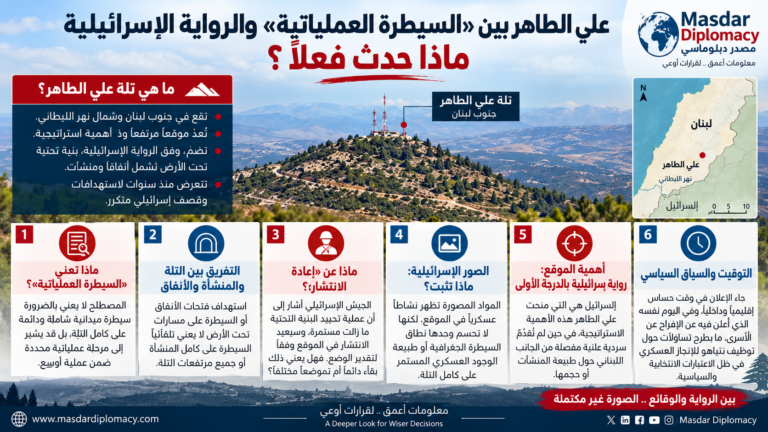
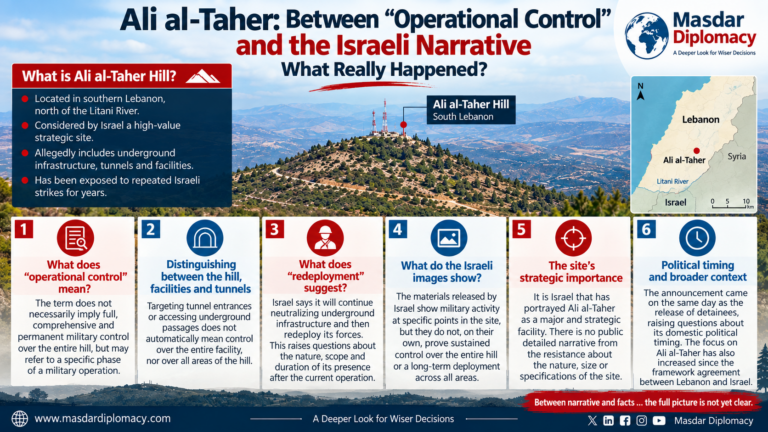
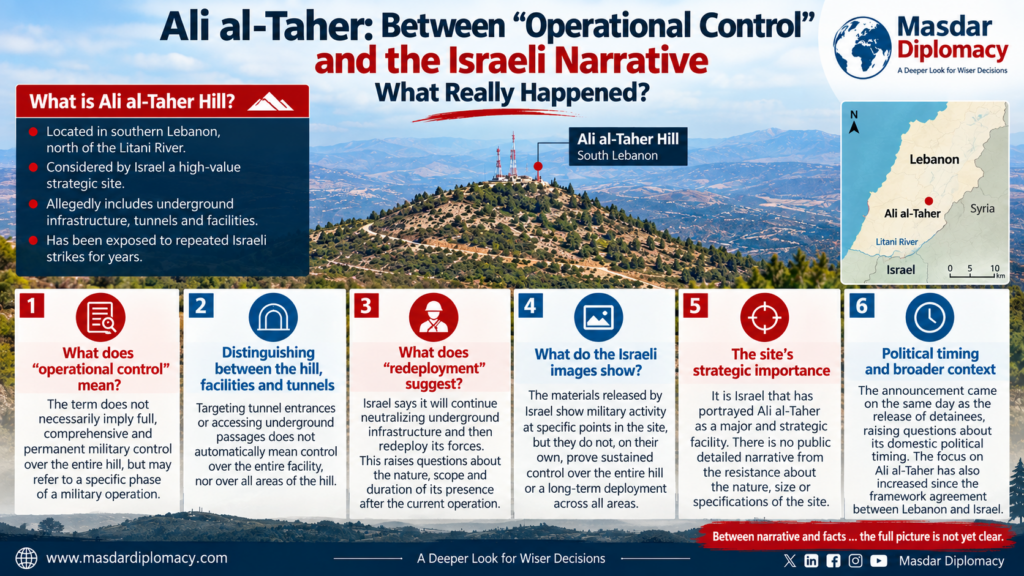
“Operational Control” Does Not Necessarily Mean Full Military Control
The first point that merits attention is Israel’s own description of what took place as “operational control.”
The term does not necessarily imply comprehensive, complete and permanent control of the entire hill, nor does it by itself establish the nature of the military deployment Israel will maintain once the current operation is over.
This distinction becomes particularly important when examining the Israeli statement itself. It said that activity aimed at neutralising the underground infrastructure was still ongoing, and indicated that the army would subsequently redeploy at the site according to the situation on the ground.
This raises a fundamental question: if the operation has not yet ended, and Israeli forces are still engaged in neutralising underground infrastructure at the site, what exactly does the “operational control” announced at this stage mean?
Does it mean that Israel has achieved complete military control of the entire ridge? Or does it describe a specific operational phase in which Israeli forces succeeded in reaching parts of the site and taking control of certain routes, entrances and facilities before moving to a different deployment posture?
The Israeli announcement, by itself, does not provide a definitive answer.
Between Control of the Hill and Control of What Lies Beneath It
There is another important distinction that needs to be made between three elements that are presented as part of a single picture in the Israeli narrative: the hill itself, the military facility located there, and the underground infrastructure and tunnels beneath it.
Targeting tunnel entrances or reaching underground passages does not automatically mean gaining control of the entire facility. Likewise, controlling part of the underground infrastructure does not necessarily amount to full military control of all of Ali al-Taher’s elevated terrain.
For that reason, references to “clearing” tunnel routes or neutralising parts of the underground infrastructure should not automatically be equated with a claim that the entire site has come under Israeli military control.
Even when two tunnel routes are discussed, it remains important to distinguish between the tunnels themselves and the facilities associated with them, rather than treating the site as a single, uniform facility.
What Does Israel’s “Redeployment” Mean?
The Israeli military’s reference to “redeploying defensively” is particularly significant in this context.
The Israeli army says it will complete the process of neutralising the infrastructure and then redeploy at the site according to the situation.
This does not necessarily mean that Israel will withdraw from Ali al-Taher. But the wording raises a legitimate question about the nature of the Israeli presence that will remain once the operation is over.
Will Israeli forces maintain a permanent position on the hill?
Will they deploy at specific points?
Or will they maintain a military presence around the site while relying on surveillance and remote strikes?
The use of the term “redeployment” after the declaration of “control” makes it necessary to distinguish between the control achieved during a military operation and the form that control and deployment will take afterwards.
This distinction matters because operational control achieved during a military operation does not necessarily mean that the same military presence or deployment pattern will continue unchanged.
Israeli Images and Footage: What Do They Actually Prove?
Israel has released images and footage related to the operation at Ali al-Taher, using them to show military activity by its forces and the underground infrastructure it says they reached and targeted.
But the existence of images or footage showing operations at the site does not, by itself, establish the geographical scope of control over the entire hill.
Images may demonstrate the presence of Israeli forces at a particular point, facility or tunnel route. They do not, on their own, prove sustained control over the entire ridge unless accompanied by clear operational information establishing the location, extent and nature of the deployment.
It is therefore important to distinguish between evidence that a military operation took place at the site and evidence of permanent control over the site as a whole.
Israel Is the Side That Has Given Ali al-Taher Its Strategic Significance
It is notable that much of the description of Ali al-Taher’s importance and of the facilities located there has come from the Israeli side itself.
Israel has portrayed the site as a large, important and strategic facility, and has linked control of it to preventing the area from being used for military purposes.
By contrast, the resistance has not previously offered a detailed public narrative about the nature, size or specifications of the facility.
It is therefore important to distinguish between the existence of a site with genuine military significance and the image Israel seeks to project regarding the scale and nature of that significance.
The more extensively Israel emphasises the site’s importance, the more necessary it becomes to treat that characterisation as part of its military and political narrative, rather than as an independently established fact beyond scrutiny.
The Question of the “Facility” and the Number of Facilities
Another issue concerns the way Ali al-Taher is described as a single “facility.”
There are indications that the site contains a number of facilities, while Israel has previously announced strikes against a facility associated with Ali al-Taher.
This raises the question of whether the current claim of “operational control” refers to the entire site or only to a specific part of its facilities and infrastructure.
If the site comprises more than one facility, route and underground network, then the announcement of control over “Ali al-Taher” requires greater precision as to what has actually been brought under control and what may remain outside its scope.
How Did Israel Reach Its Conclusion Regarding Iranian Presence?
Another point that warrants scrutiny is Israel’s claim that there were no Iranians inside the facility.
The question here is not whether Iranians were or were not present, but what intelligence basis Israel used to reach that conclusion.
In what has been publicly announced, the Israeli side has not provided details explaining the nature of the information on which it based its identification of those inside the facility, or its assertion that no Iranians were present.
Accordingly, this information should be treated as part of the Israeli narrative that warrants critical examination, rather than as an independently established fact.
A Site Targeted for Years
Another factor that should be taken into account when assessing the latest development is that Ali al-Taher Hill did not suddenly emerge as a target of Israeli military operations.
The site has been subjected to sustained and heavy Israeli bombardment and strikes over the past three years.
This means that the current announcement comes after a prolonged period of military targeting, rather than as the result of an isolated operation that began only in the hours preceding the announcement.
This raises another question: What changed on the ground that led Israel to announce “operational control” now?
Does this reflect a change in the nature of the military operation, or a change in the way Israel is characterising the results of its previous and ongoing operations?
Ambiguity Does Not Mean Acceptance of the Israeli Narrative
Throughout this confrontation, the resistance has, for months, followed a policy of constructive ambiguity, refraining from issuing a detailed battlefield narrative about its clashes with Israel, including in cases where Israel announced casualties among its forces or claimed that particular strikes had prompted it to expand its operations in different parts of the south.
The absence of a competing narrative or detailed battlefield account should therefore not automatically be interpreted as acceptance of the Israeli narrative.
At the same time, the absence of a counter-narrative does not in itself constitute evidence disproving what Israel has announced.
The point is that the information currently available still leaves considerable uncertainty over the nature and scope of the control Israel says it has achieved.
The Political Timing of the Announcement
The Israeli announcement cannot be separated from its political context.
On the same day that the release of detainees was announced, Israel issued its statement on the Ali al-Taher operation at night, giving the development a prominent military dimension in the Israeli narrative.
This raises questions about the extent to which Netanyahu may be seeking to leverage military and security achievements at this stage, particularly in light of domestic political and electoral considerations in Israel.
This does not necessarily mean that the operation did not take place or that the announcement was not based on genuine military activity. It does, however, call for a more cautious assessment of the scale of the achievement that Israel’s leadership has chosen to highlight and the manner in which it has presented it to the public.
Ali al-Taher After the Framework Agreement
The announcement concerning Ali al-Taher also takes on added significance in light of its political timing.
The Israeli discussion of the site and its seizure acquired its current dimension only after the framework agreement signed by the Lebanese authorities with Israel. According to the Lebanese reading, the agreement provided Israel with greater room for military movement and a justification for continuing its military operations, demolitions and detonations in the south.
From this perspective, Ali al-Taher cannot be viewed simply as an isolated military position. It is also part of the broader struggle over the nature of the security arrangements that will emerge in southern Lebanon in the next phase.
Why Was the Question of Ali al-Taher Not Settled by the Lebanese Army?
This context also brought the question of handing Ali al-Taher over to the Lebanese Army to the fore. The proposal was that the Lebanese Army would take over the site if Israel withdrew from it.
The position attributed to the Lebanese Army, however, is that it cannot take control of a position it lacks the ability to defend, particularly in the absence of guarantees preventing Israel from entering it again after it has been handed over to the army.
This issue highlights a fundamental dimension of the problem: Who controls the site after any Israeli withdrawal? Who has the capacity to protect it? And who can guarantee that it will not become a new flashpoint?
Is the Site Outside the Arrangements Governing South of the Litani?
This issue is also connected to the geographical location of Ali al-Taher.
The site lies outside the area south of the Litani River that has been associated with the arrangements under Resolution 1701 and the established military deployment there. The resistance therefore regards the status of Ali al-Taher as distinct from that of positions south of the Litani, linking it instead to internal dialogue and a broader national security strategy.
From this perspective, the resistance has considered itself not bound by the US request concerning the handover of Ali al-Taher to the Lebanese Army, particularly since, according to this account, the Lebanese Army itself had not asked the resistance to hand over the site.
Conclusion
Between Israel’s declaration of “operational control,” visual material showing military activity at the site, and the questions that remain over the scope of that control and the nature of Israel’s deployment after the underground infrastructure has been neutralised, the description of Ali al-Taher as having “fallen into Israeli hands” does not appear sufficient to accurately capture the situation.
The information released by Israel supports the conclusion that it carried out a military operation in the area and targeted underground infrastructure. It does not, however, by itself answer the questions surrounding the extent of its control over the entire ridge, or the nature of the presence that will remain there once the operation is complete.
The key question, therefore, is not whether Israel has achieved a military advance at Ali al-Taher, but what exactly the “operational control” it announced means, and whether it amounts to full and sustained military control of the hill or represents an operational outcome tied to a specific phase of a broader military operation.
The gap between what Israel has announced and what can be independently established about the scope and durability of its control is precisely what makes the claim that the hill has “fallen” worthy of scrutiny, rather than something to be treated as an established fact.