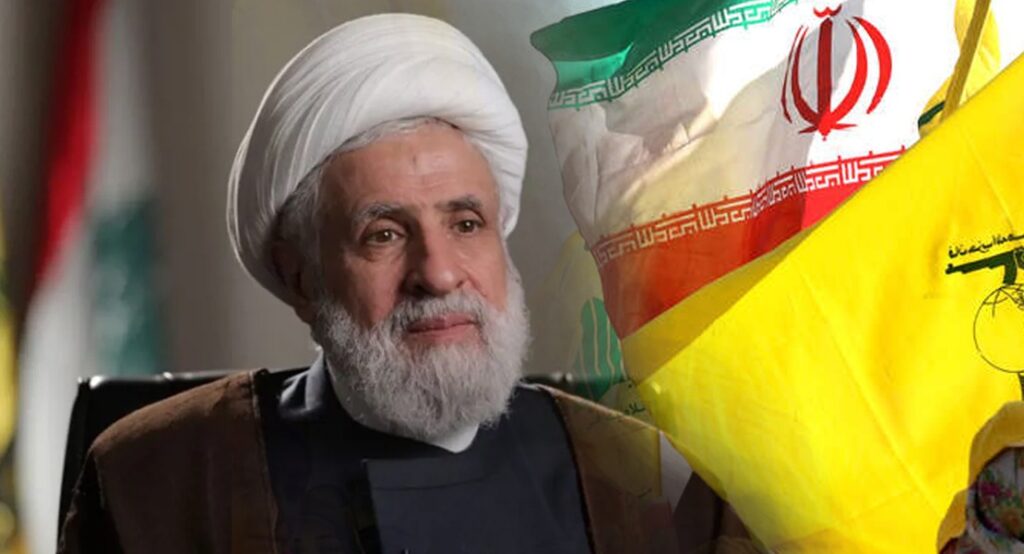
أثارت كلمة الأمين العام لحزب الله، الشيخ نعيم قاسم خلال اللقاء الجماهيري تضامنًا مع إيران، جدلا حول طبيعتها بين التهديد المباشر أو الردع السياسي المحسوب
Masdar Diplomacy”
By Marlene Khalife
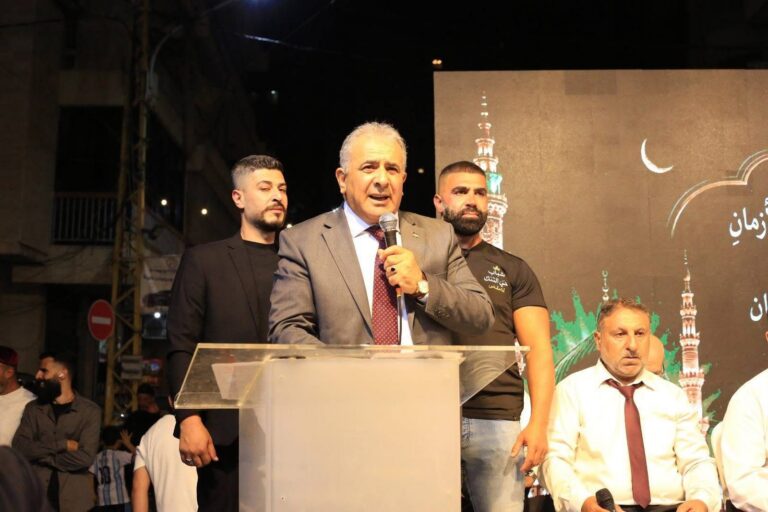
The speech delivered by Hezbollah’s Secretary-General, Sheikh Naim Qassem, during a mass rally in solidarity with Iran has sparked debate over its nature—whether it constituted a direct threat or a form of calibrated political deterrence.
Well-informed circles within Hezbollah convey that the significance of what Sheikh Naim Qassem stated cannot be separated from the prevailing political and security context. The speech reiterated that UN Security Council Resolution 1701 has not seen a single clause implemented by the Israeli side, a reality that has kept the state of war open between the two parties, even if nominally framed as a ceasefire and the one-sided application of the resolution. These circles point out that one of the first outcomes of the speech was to expose the falsity of narratives promoting the idea of Hezbollah’s defeat or its entry into a phase of incapacity. Evidence of this lies in the fact that those who rushed first to respond to and comment on the speech were the very same actors who propagate such narratives—an indication that Hezbollah continues to be treated as an active and influential force.
They also note that the address demonstrated Hezbollah’s parity and assertiveness in engaging with everything said in recent periods, whether in domestic political discourse or in debates related to state-building. It reaffirmed that such state-building cannot occur through the exclusion of a fundamental and sacrificial political component in Lebanon. On the contrary, this component views its sacrifices in blood, finances, and livelihoods as having constituted a condition for the very existence and continuity of the state.
In this context, the circles emphasize that Sheikh Qassem’s speech does not fall within the category of a declaration of war; rather, it is a calculated political deterrence speech aimed at entrenching existing equations and imposing realities within regional and international calculations, without sliding into direct field escalation. Indeed, a full reading of the speech text clearly shows that it is neither a declaration of war nor a pledge of automatic support for Iran, but rather….it is a calculated political deterrence speech aimed at entrenching existing equations and imposing realities within regional and international calculations, without sliding into direct field escalation.
Indeed, a full reading of the speech text clearly shows that it is neither a declaration of war nor a pledge of automatic support for Iran, but rather a precise political message directed at both Washington and Tel Aviv for the purposes of deterrence and strategic calculation.
The language used in the speech carries a high mobilizational charge, yet in essence it is directed inward—to strengthen Hezbollah’s position at the negotiating table—more than it is an announcement of imminent military action.
For example, the speech stated:
“We will choose, at the appropriate time, how to act—whether to intervene or not—and we will determine that according to the existing interest.”
This is a central phrase that clarifies that any decision regarding military intervention is linked to interest and circumstance, not to an automatic commitment or an explicit threat.
This flexible framing of decision-making shows that Hezbollah places itself within the realm of strategic deterrence, preserving freedom of action and refusing to submit to any external pressure—an approach that distinguishes it from rhetoric intended to incite war or immediate field escalation.
Qassem also revealed that the party had been confronted with a question from mediators: “If Israel and the United States go to war against Iran, will Hezbollah intervene or not?”
He added: “The mediators told us clearly: Do we strike Hezbollah first? Or Iran first? Or both together?”
The disclosure of this question, and its transmission to the public, is not intended as a direct threat, but rather to impose Hezbollah as a calculated factor in the strategic equations of both the American and Israeli sides, and to show that any move against Iran would be complicated by Hezbollah’s presence as a local and regional deterrent force.
Despite the mobilizational and emotional language associated with the Supreme Leader, which includes phrases such as “Our blood is not ours to spend, and our resistance cannot act without legitimate authorization,” and “Let us be one hand, and let us cry out with one voice: Labbayka ya Khamenei,” their primary function is internal.
They aim to solidify doctrinal commitment and enhance popular mobilization and legitimacy, rather than to issue combat orders or direct threats. This language underscores the doctrinal relationship between the party and the Supreme Leader, yet it does not translate into a declaration of a specific military operation, reflecting a clear separation between doctrinal commitment and political-military decision-making.
The speech also focused on the narrative of defending the party’s national and historical interest, affirming that any potential intervention or military action would be determined according to field conditions and strategic interest. It clarified Hezbollah’s stance toward attempts to impose neutrality upon it: “But we are not neutral… As for how we act, these are details determined by the battle and defined according to the existing interest.”
This statement clearly defines the nature of the speech as a deterrent message rather than a threat, and demonstrates the party’s ability to balance doctrinal commitment with political flexibility—granting it broad leeway to assess interest before taking any step.
Qassem’s disclosure of the details of the questions raised by mediators regarding the sequencing of potential strikes can also be seen as part of a strategy of indirect deterrence. It conveys an implicit message to the concerned parties that Hezbollah will not be a mere number in the calculations, and that any plan targeting Iran must take into account its role and potential impact. This mode of communication reflects the party’s capacity to exert political pressure and maintain its strategic standing without directly engaging in the conflict—an element that distinguishes political deterrence discourse from direct threats.
Sheikh Qassem’s address is thus a calculated political deterrence speech. It sends a clear message to both the American and Israeli sides that Hezbollah is a factor that must be taken into account, without offering a commitment to war or issuing a direct military threat.
It is a blend of internal mobilization, doctrinal messaging, and intelligent political strategy, reflecting the party’s ability to balance ideological commitment with practical interest, while preserving freedom of decision and action according to field conditions, without immediate field escalation. This reading indicates that the primary objective of the speech was to deliver a measured deterrence message—not to declare war—while maintaining a strong position both domestically and externally, according to circles with broad insight into the climate within “Hezbollah.”
To Continue reading subscribe NOW