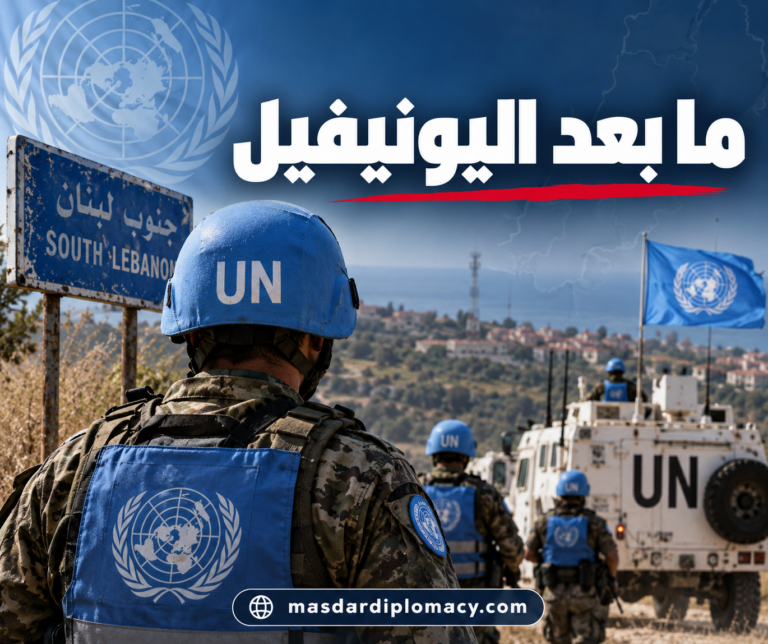
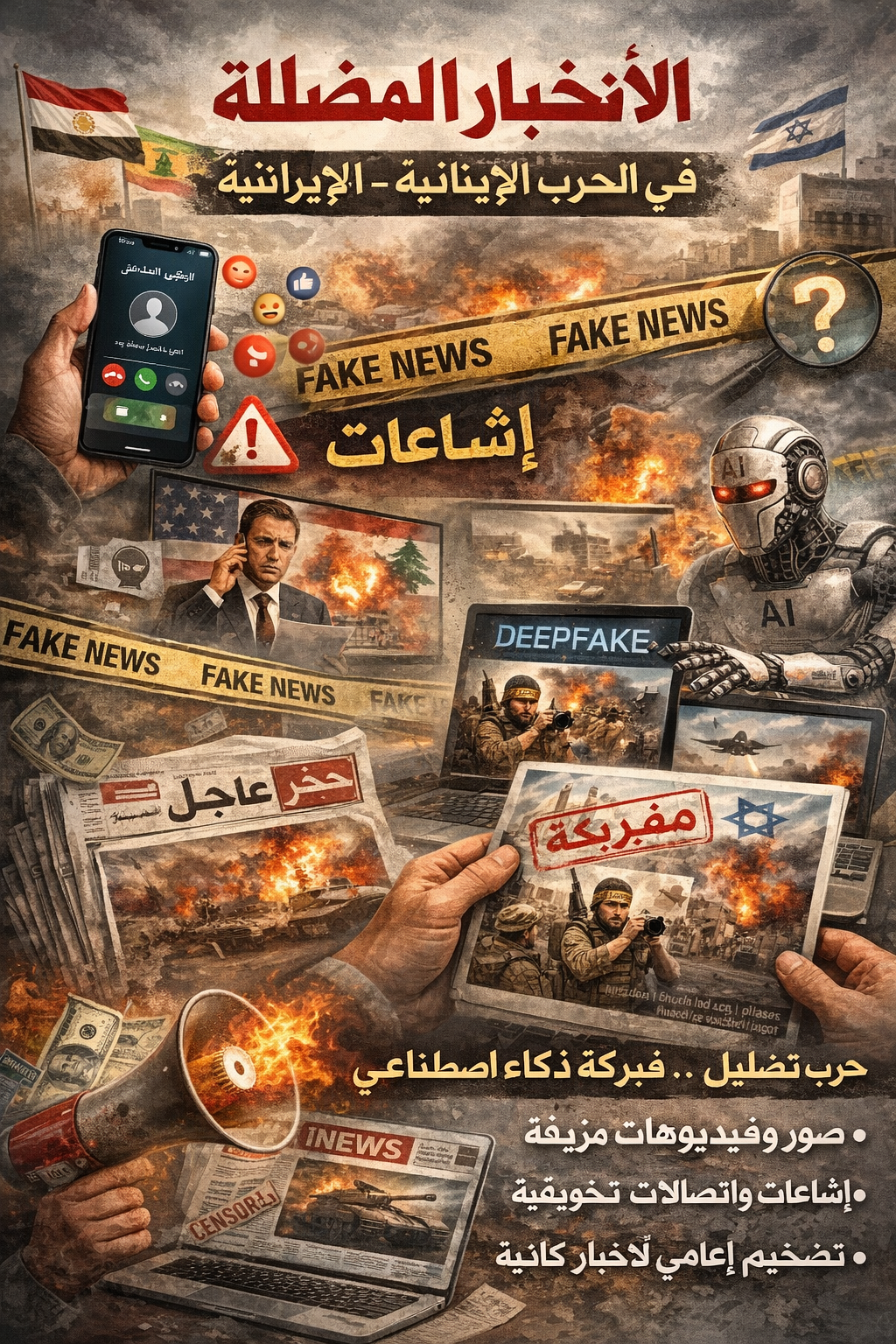
ملصق تعبيري عن الاخبار المضللة من انتاج الذكاء الاصطناعي
By Marlene Khalife –Masdar Diplomacy
The confrontation that has been ongoing since February 28 through today, April 14, between Iran and the United States on one side, and Lebanon and Israel on the other, is not confined to the military battlefield. It has expanded into a full-fledged information war.
Lebanon is currently witnessing a massive surge in misinformation aimed at destabilizing the domestic front and sowing division among its people. Social media platforms, along with certain media outlets—newspapers, television channels, and websites funded by partisan or foreign actors—are playing a dangerous role in promoting fabricated narratives.
Blindly believing and sharing unverified information fuels collective panic and serves the agendas of psychological warfare. Readers must exercise critical judgment, rely on official and field-based sources, and turn to correspondents who adhere to minimum standards of neutrality and professional integrity before circulating any news.
“Masdar Diplomacy ” has tracked the ten most prominent misleading stories, noting that many more exist and cannot all be captured in a single report.
1. Ismail Qaani: From “Espionage Allegations” to Public Reappearance
Rumors circulated claiming that Quds Force commander Ismail Qaani was an Israeli agent under investigation in Iran. In reality, Qaani later appeared at official events and broke his silence through statements and messages reaffirming continued support for the resistance.
Key message: Iran will stand by the resistance until victory is achieved, and the support front will not cease—directly refuting accusations promoted by hostile media.
Sources: Tasnim News Agency and official IRGC-affiliated channels.
2. Israeli Advance and the Litani River: Geographic Distortions
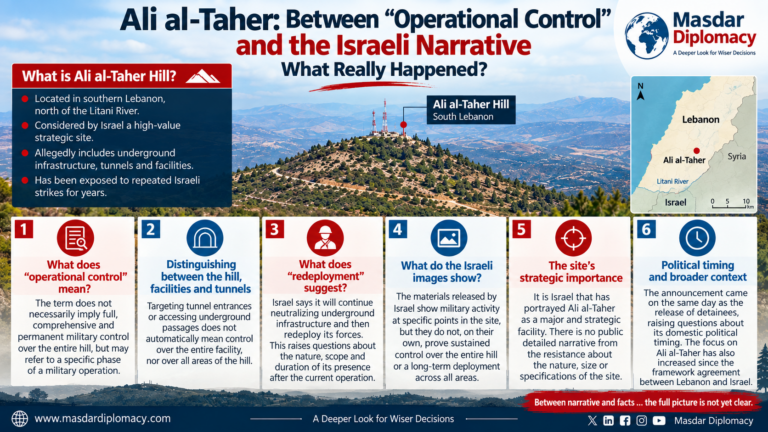
Reports claimed a large-scale Israeli advance toward the Litani River. In fact, the river stretches 170 km entirely within Lebanese territory.
On the ground: Israeli incursions remain confined to forward-edge combat zones. The distance ranges from 5 km (Kfarkela axis) to 35 km (Naqoura axis) from certain border points. Israeli forces have not reached the river, contrary to exaggerated claims.
Sources: UNIFIL data, field reports, and Lebanese military maps.
3. Assassination Claims: A Recycled Psychological Warfare Tactic
False reports repeatedly alleged the assassination of figures including MP Mohammad Raad, Mahmoud Qomati, Wafiq Safa, and even Hezbollah Secretary-General Sheikh Naim Qassem.
These claims fall within psychological warfare operations. Sheikh Qassem has appeared multiple times on television—most recently yesterday—while other officials continue their duties discreetly for security reasons.
Sources: Hezbollah media relations and documented public appearances.
4. Syrian Forces in the Bekaa: Attempts to Drag Damascus into the War
Certain platforms claimed Syrian forces had entered the Bekaa Valley, while others alleged Hezbollah was mobilizing along the Syrian border.
The Syrian Foreign Minister denied any such movement. Informed sources confirmed to “Diplomatic Source” that Hezbollah remains fully focused on the southern front and has no interest in diverting its forces.
Sources: Syrian Foreign Ministry, Lebanese security reports, informed sources.
5. The “Coup” Against Prime Minister Nawaf Salam and the April 8 Massacre Narrative
A widely circulated claim alleged Hezbollah was preparing a coup to seize government headquarters, which Israel used to justify attacks on civilians in Beirut.
In reality, protests were spontaneous civilian demonstrations opposing the negotiation track with Israel, officially set to begin today at 6 p.m. Beirut time. Amal Movement and Hezbollah jointly called for restraint and urged supporters to avoid protests to prevent unrest.
Sources: Masdar Diplomacy contacts and joint Amal–Hezbollah statement.
6. “Iran Has Abandoned Hezbollah”
A misleading narrative attempted to portray Hezbollah as isolated.
Iranian Foreign Minister Abbas Araghchi dismissed these claims. Moreover, Lebanon’s inclusion as a priority in indirect Iran–U.S. negotiations (in Oman/Pakistan) underscores the depth of the alliance.
Sources: Official Iranian statements and diplomatic reporting.
7. Suspicious Phone Calls: A Tool of Intimidation
Lebanese citizens received calls impersonating international or security agencies, urging them to evacuate their homes.
Investigations revealed these to be cyber operations originating from Israel, aimed at spreading fear, inducing displacement, and testing public reactions.
Sources: Lebanese Ministry of Telecommunications and Internal Security Forces.
8. AI and Fabricated Footage: Beirut Airport as a Case Study
Deepfake images and videos circulated alleging weapons depots or strikes at Beirut’s Rafic Hariri International Airport.
These materials were either AI-generated or taken out of context from previous conflicts. Public Works Minister Ali Hamieh organized media and diplomatic tours of the airport to debunk the claims.
Sources: Press tours and digital forensics tools.
9. The Myth of a Cabinet Vote to Demilitarize Beirut
Reports claimed the Lebanese Cabinet unanimously voted to declare Beirut a demilitarized city, suggesting divisions between Amal and Hezbollah.
The truth: No vote took place. What occurred was a heated discussion, during which several ministers voiced objections. The measure was passed procedurally without a formal vote. Hezbollah ministers rejected it outright, while Amal ministers expressed تحفظ (reservations), disproving claims of consensus.
Sources: Minister Tamara El Zein’s statement, official cabinet records, Masdar Diplomacy contacts.
10. The Bint Jbeil Front: Resilience vs. Propaganda
Israeli-linked platforms and local outlets claimed that Bint Jbeil had fallen and that Hezbollah requested safe passage for its fighters.
In reality, fighting remains intense on the outskirts, with resistance forces carrying out targeted ambushes. There has been no request for safe passage—only documented battlefield resilience.
Sources: Field correspondent Samer Al-Hajj Hassan, Al-Manar TV, military media, independent sources.