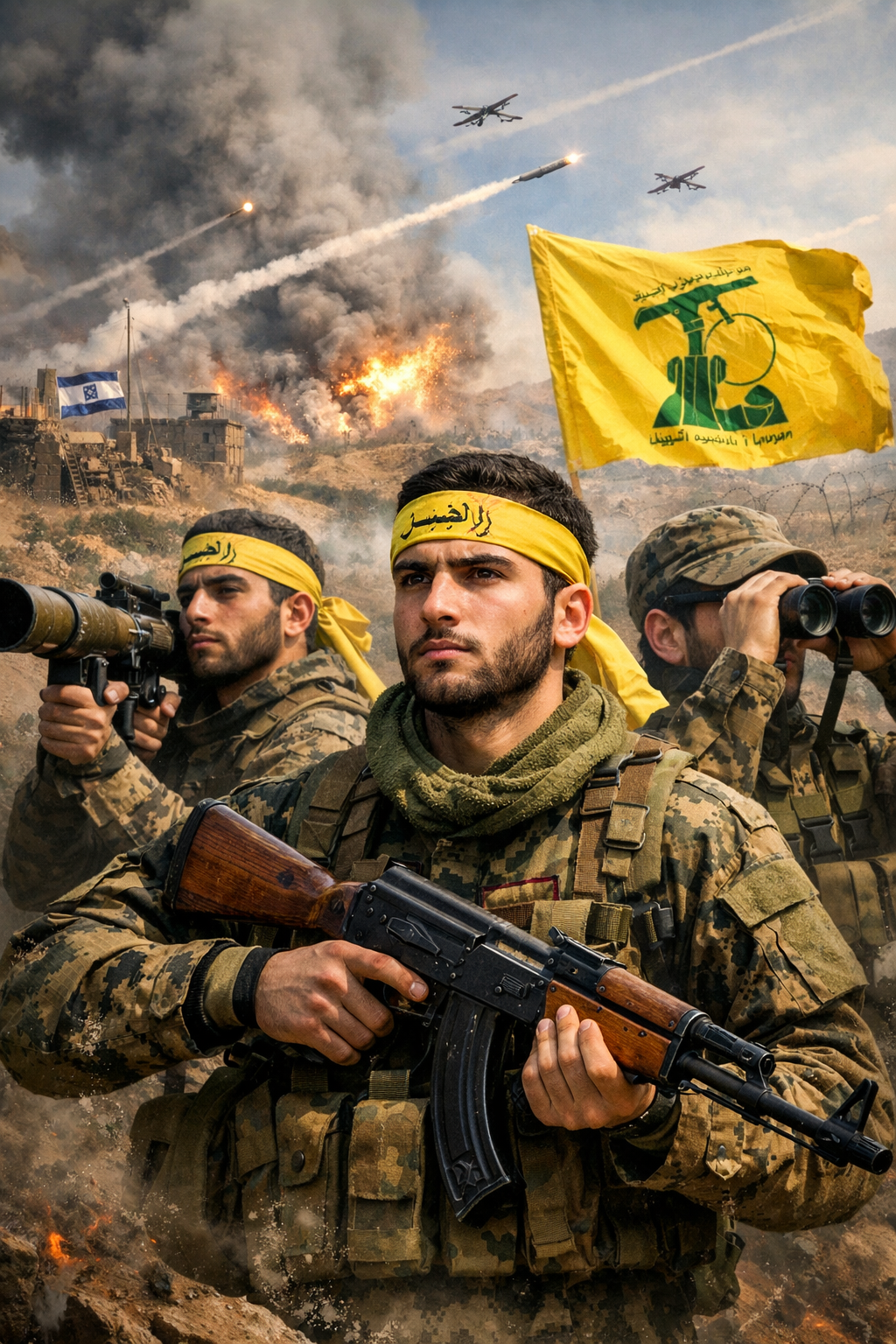
جيل المقاومة الثالث:وجوه شابة في قلب المواجهة. (الصورة تعبيرية من انتاج الذكاء الاصطناعي)
Masdar Diplomacy
By Marlene Khalife
While research centers in Tel Aviv were promoting theories of a “fragmented command structure” within Hezbollah following a series of assassinations that targeted the founding generation and placed the second tier under direct threat, the contours of a “third generation” emerged from beneath the rubble of airstrikes—one that has been leading the battles against Israel since the beginning of March.
A cohort of young fighters—armed with fresh resolve, technical acumen, and an unhesitating drive—has assumed control of battlefield initiative, transforming what was perceived as a fleeting “Israeli euphoria” into a ground-level nightmare unsettling Israeli generals, as acknowledged by leading voices in the Israeli press.
The magnitude of this operational shift is reflected in Hezbollah’s ability to transition smoothly to a third generation of cadres, who have taken command despite the heavy targeting of historic and mid-level leadership, particularly during the widely reported pager operation in September 2023.
This generation—honed by regional conflicts and raised in the shadow of the 2006 victory—has introduced a new dimension to the confrontation, marked by intensity and unconventional momentum. The engagement is no longer confined to familiar defensive frameworks; instead, it has evolved into the execution of lethal close-range ambushes that catch Israeli elite units off guard and inflict tangible losses.
Further complicating the battlefield is this generation’s reliance on decentralized command structures, whereby each fighting unit in border villages operates as an “independent command,” managing its engagements with high tactical flexibility—rendering the identification of a singular command apex virtually impossible. This continuous infusion of new blood has not only revitalized the resistance but has enabled it to reclaim the initiative at a moment when Israel believed the organization had been exhausted. The result: illusions of rapid progress have given way to a war of attrition marked by mounting costs that exceed Israeli projections and calculations.
Paid “Analysis”
Away from the battlefield, a parallel phenomenon has emerged in Lebanon: that of “directed journalism,” where some reporting aligns with the agendas of financiers. Certain journalists—some directly linked to Qatari circles—have, since day one, promoted fantastical scenarios. At times, they have spoken in social media posts and reports of a ground invasion reaching the city of Sidon; at others, they have advanced claims of “evacuating resistance fighters” from the south toward the western Bekaa, only to be trapped in a “pincer” between Israeli forces and Syrian units affiliated with Ahmad al-Sharaa.
Such “information,” presented as credible analysis, amounts to little more than wishful thinking aligned with external agendas, entirely disconnected from realities on the ground.
Contrary to the claims of these “media operations rooms,” well-informed sources confirm that the resistance has prevented Israeli forces from consolidating positions even a few meters inside Lebanese villages.
- In towns such as Aita al-Shaab, al-Qouzah, al-Khiam, and al-Taybeh, Israeli forces were caught in tightly coordinated ambushes that forced the Israeli Air Force to deploy “fire belts” over the heads of its own engaged troops—at times resembling the unofficial application of the Hannibal Protocol—in order to disengage, after tanks failed to provide adequate cover for infantry due to being targeted by Almas missiles and third-generation Kornet systems.
- Enemy concentrations were destroyed at Fatima Gate and in the vicinity of the Metula settlement, effectively turning the forward edge into a graveyard for military vehicles, most notably Merkava tanks.
The Resistance and Syria: Debunking Falsehoods
Some commentators have attempted to drag Syria into the conflict through unfounded claims that the resistance is provoking the Syrian side to open a second front. This narrative—particularly promoted by Qatari media—is transparent. The resistance leadership has repeatedly affirmed that it does not interfere in Syrian affairs and that its battle is confined to confronting the Israeli enemy along the Lebanese border. Any attempt to conflate these fronts serves a broader U.S. strategy aimed at fragmenting the region.
Both the resistance’s leadership and its constituency have reached a clear conclusion: there will be no deceptive ceasefire that grants the enemy an فرصة to regroup, as occurred in previous experiences. This is framed as a “war of dignity,” with demands now clearly articulated—reportedly aligned with Tehran in full coordination across fronts:
- An end to the war, not merely a ceasefire—a comprehensive halt to all military and aggressive operations.
- Comprehensiveness—ending the war across all fronts (Lebanon, Iraq, Yemen, and Iran) as a unified whole.
- Full sovereignty—implementation of conditions ensuring each state’s sovereignty over its territory without Israeli or American security interference.
What is unfolding on the ground today is not merely a war of attrition; it represents a structural failure in Israeli and American intelligence assessments, which assumed that eliminating the historical leadership structure would precipitate the collapse of the resistance. Instead, the “third generation” has emerged with an unexpected response—one combining momentum, technical expertise, and ferocity, leaving elite Israeli units reeling in the narrow alleys of border villages.
While media outlets funded by Qatari circles remain preoccupied with constructing fictional narratives of withdrawals and encirclement involving Syrian forces affiliated with Ahmad al-Sharaa, the facts on the ground tell a different story: such “media toxins” exist only on the screens and platforms of their sponsors, while the sole reality is being written in bullets and rockets in the south.