
لحظة وصول البابا ليون الرابع عشر الى مطار رفيق الحريري الدولي والقائه التحية على منظريه من مسؤولين وحشود
Masdar Diplomacy
By Marlene Khalife
Sunday, November 30, 2025, was no ordinary day in Lebanon. Even the air seemed infused with the scent of rain, anticipation, and holiness—as if the entire country had collectively decided to set its pain aside for a moment, offering its extraordinary guest, Pope Leo XIV, the very best it has in affection, patience, and longing for joy.
The day began early at Beirut–Rafic Hariri International Airport, as journalists made their way from the media center at the Phoenicia Hotel after long hours of preparation and coordination.

At the Phoenicia, a hive of constant activity, the director of the media center and adviser to the President, Rafic Chlala, announced that more than 1,300 journalists from 22 countries had registered to cover the visit. A dedicated hall was set up for the Stampa corps and the Vatican and Italian media, while dozens of computers and technical support stations were prepared. The presidential media team worked tirelessly to manage the overwhelming influx, their calm professionalism easing the tension and turning fraught moments into smiles just minutes before the papal plane touched down.
The “White Angel” Lands in Beirut
At 3:45 p.m., the bright white fuselage of the papal aircraft glided into view, drawing a wave of emotion as “the White Angel,” as many had called him, Pope Leo XIV, arrived on his first foreign apostolic journey following his visit to Turkey.

The official reception matched the magnitude of the moment: President Joseph Aoun and First Lady Naamat Aoun, Speaker Nabih Berri and his wife Randa Berri, and Prime Minister Nawaf Salam with his wife Sahar Baassiri greeted him at the foot of the aircraft.
Rows of Lebanese Army soldiers lined the red carpet as the military band played official marches. Lebanese and Vatican flags fluttered above crowds of citizens and clergy who had gathered with a fervor befitting a historic day.

At the aircraft door, two children from the pediatric oncology center approached, carrying a platter of bread, salt, and Lebanese soil. The Pope blessed it, broke a small piece of bread and tasted it reverently, then extended his hand to bless the children. Moments later, a 21-gun salute echoed across the tarmac, signaling his arrival on Lebanese soil.
The cheers of the crowd mingled with the music and the rain—as though Lebanon, for the first time in a long while, was able to catch its breath.
The Southern Suburbs Offer a Unique Mosaic of Coexistence
From the airport, the papal motorcade made its way toward Baabda Palace, escorted by army helicopters that had tracked the Pope’s plane from the moment it entered Lebanese airspace.
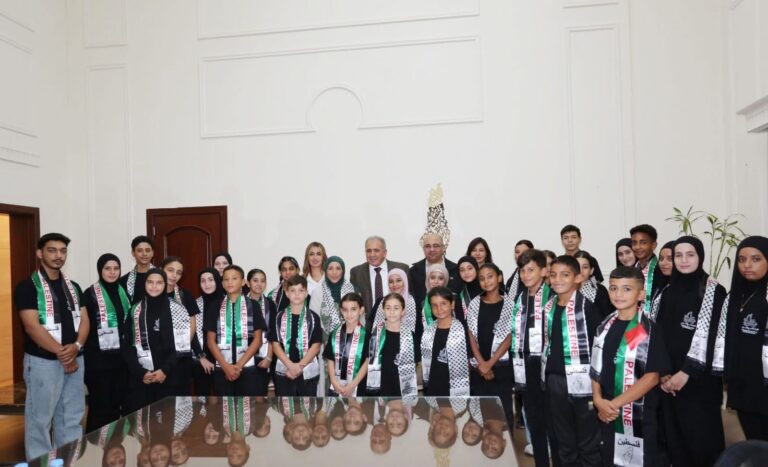
Along the route, an unprecedented scene unfolded: a human mosaic of Shiite residents and members of Hezbollah’s social environment, including children from the “Mahdi Scouts,” dressed in their uniforms and holding small flags. Children as young as four stood in the pouring rain, playing welcome melodies and waving Vatican and Lebanese flags.

Veiled women, young men in rain gear, elderly men holding the Pope’s portrait—groups gathered spontaneously, chanting his name. All had come to tell their fellow citizen, and their guest, that Lebanon remains capable of creating a moment of genuine coexistence unlike anything else.
Hezbollah, through both its welcoming statement on the eve of the visit and the crowds that filled the streets, offered an unprecedented gesture of Christian–Muslim partnership. Those who lined the road did not dwell on the controversial statement issued earlier by the Lebanese Forces. They did not pause over their own wounds or the buildings still scarred by Israeli bombardment. Even the shock of the assassination of senior commander Haitham al-Tabtabai just one week earlier did not deter them.
They came out to the streets to offer a living lesson from the Gospel: “Love never fails.” They embodied this verse through action—not words.

Onward to Baabda: Dance, Banners, and the Dove of Peace
The crowds thickened as the motorcade approached Baabda Palace. Banners stretched along the road: “Pope of Peace,” “Welcome to the Land of the Message,” “Lebanon Opens Its Heart.” Under the gentle rain, a Baalbek folk dance troupe stood along the roadside, their steps matching the rhythm of lively music—difficult to pass by without breaking into a smile.
The Pope arrived in the popemobile amid cheers and a sea of waving flags. In the courtyard of the presidential palace, he was greeted with a breathtaking three-dimensional artistic display: a dove of peace soaring above cedar trees, with his likeness rising in light and shadow as though touching the Baabda sky.
The Pope appeared visibly moved, contemplating the artwork before exchanging words with the President, who opened the reception with an address on the importance of peace and Lebanon’s role in interfaith dialogue.

Then came an emotional moment: a performance by a group of deaf and mute children, who welcomed him with songs expressed through sign language—silent yet deeply resonant.
The Pope then entered the Golden Hall, where he wrote his message in the Golden Book, adding a new chapter to the history of papal visits to Lebanon.
To Harissa… and an Evening of Spiritual Calm
Pope Leo XIV later departed Baabda toward Harissa. At the Carmelite Sisters’ monastery, serenity awaited him after hours of joyful tumult. He met with the nuns, shared conversation and prayer, and posed for commemorative photographs before heading to the Apostolic Nunciature in Harissa, where he spent his first night in Lebanon.

And so ended the first day of Pope Leo XIV’s visit to Lebanon—a day filled with rain, tears, smiles, prayers, and the scent of bread, salt, and earth.
A day in which Lebanon told the world: We are still here… and still capable of creating both wonder and holiness at once.