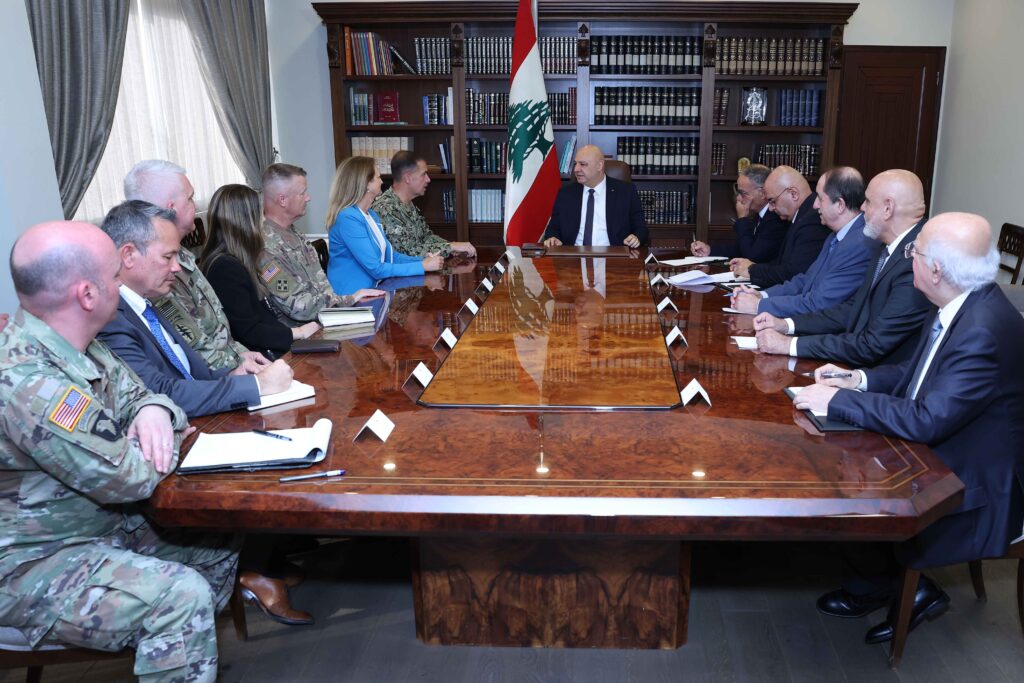
Yesterday, President Joseph Aoun received the U.S. delegation, led by General Cooper, in the presence of General Lenny and U.S. Ambassador Lisa Johnson, at Baabda Palace.
By Marlene Khalife – Masdar Diplomacy
The Lebanese political track was brought back to stability on Friday, September 5, after weeks of escalating tensions that had threatened to drag the country into chaos. The turning point came during the Cabinet session, where the Lebanese Armed Forces (LAF) presented a comprehensive security plan, underscoring the seriousness of the military institution in carrying out its assigned duties. Yet the execution of the plan remains tied to available resources, operational realities, and political constraints—not least Hezbollah’s objections to certain measures.
President Joseph Aoun stepped in with a flexible political formula that complemented the army’s technical plan, offering a practical roadmap without getting entangled in unrealistic deadlines. This approach sent a strong message: Lebanon is genuinely committed to placing arms solely in the hands of state institutions, while simultaneously depriving Israel and its allies of the argument that Beirut is failing to live up to its obligations.
The Cabinet’s decisions last Friday reflected this balance. They endorsed a permanent ceasefire and a non-retaliation policy to Israeli attacks, approved a nationwide arms-control strategy, adopted the LAF’s detailed operational plan, and reaffirmed Lebanon’s commitment to international agreements, the presidential oath, and the ministerial statement. Crucially, the government also opened the door to developing a comprehensive national security strategy.
This balance between national imperatives and international expectations was reinforced two days later, when President Aoun received U.S. Central Command (CENTCOM) Commander Gen. Brad Cooper at Baabda Palace, in the presence of U.S. Ambassador Lisa Johnson. In what amounted to a diplomatic maneuver, Aoun pressed Washington to accept Lebanese amendments to U.S. envoy Tom Barrack’s paper—placing Lebanon’s priorities first. Those include the full implementation of UN Security Council Resolution 1701: halting Israeli aggression, securing the withdrawal of Israeli forces from occupied hills and territories—among them the nine disputed points along the border—and securing the release of prisoners.
“These steps,” Aoun stressed, “are the practical entry point for consolidating the state’s exclusive authority over arms,” a position that was reaffirmed by the Cabinet, which welcomed the army’s plan.
In the official transcript of the meeting with Gen. Cooper, Aoun requested the activation of the UN-supervised “Mechanism” for monitoring hostilities, in order to ensure the implementation of what was agreed upon last November: ending Israeli violations, completing the withdrawal from occupied areas, and facilitating the return of detainees—all within the framework of Resolution 1701.
Holding Israel Accountable
At the same time, President Aoun placed direct responsibility on Israel for obstructing the full deployment of the Lebanese army along the international border. In the presence of Mechanism Chairman Gen. Michael Lenny, Aoun pointed out that ongoing Israeli violations undermine the LAF’s mission, despite its success in securing more than 85 percent of the territory south of the Litani River. The army has been working to curb armed activity, seize weapons and munitions, and neutralize threats in extremely difficult terrain—efforts that have cost the lives of 12 officers and soldiers during demining and ordnance disposal operations. The LAF has also begun taking control of Palestinian weapons from several camps, in line with an agreement reached during President Mahmoud Abbas’s visit to Lebanon.
Anchoring Legitimacy and Stability
Through this dual track, Aoun crafted a distinctly Lebanese formula: one that avoids provoking domestic sensitivities while at the same time reasserting the state’s commitments to international law, the presidential oath, and the ministerial program. According to political sources, these measures have put Israel in an awkward position internationally, stripping it of the ability to accuse Lebanon of negligence.
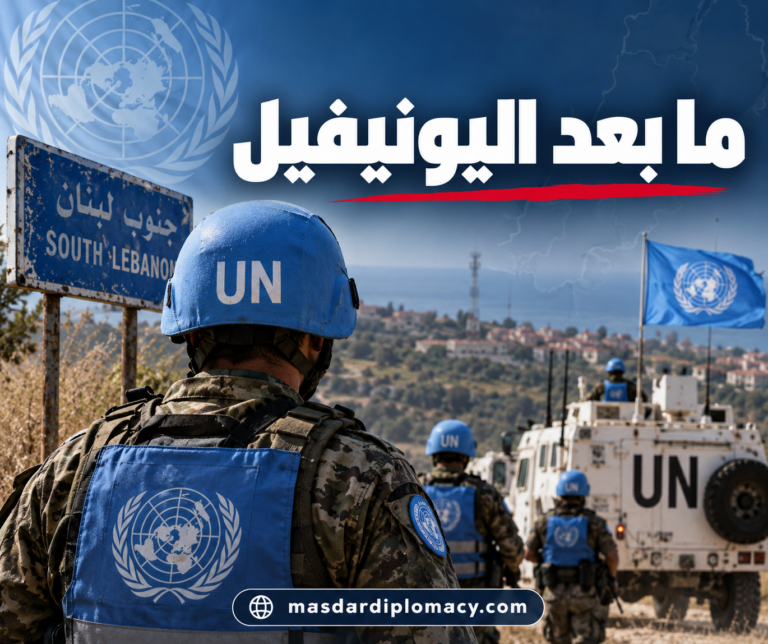
Aoun also underscored to Gen. Cooper the importance of sustained U.S. support for the Lebanese army—providing equipment, vehicles, and logistical assistance to help it secure borders, combat smuggling and terrorism, and maintain nationwide stability. Strengthening the LAF, he stressed, directly bolsters Lebanon’s stability at a time when soldiers are enduring severe economic hardship. He further highlighted the importance of coordination with UNIFIL, which has contributed to relative calm in recent months, opening space for economic progress and raising the prospects of reconstruction with support from friendly states once hostilities cease.