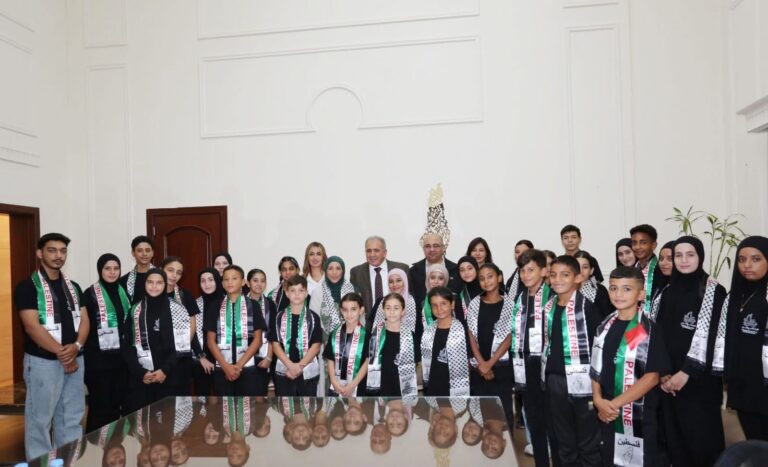

بدأ الجنوبيون بالعودة الى قرهم وبلداتهم منذ فجر اليوم الجمعة في 17 نيسان ، بالرغم من تحذيرات قيادة الجيش ومسؤولين في حركة أمل وحزب الله من أن العودة مبكرة لأن الهدنة قد تكون هشة وهي لعشرة ايام وقد تنتكس
Masdar Diplomacy
By Marlene Khalife
Lebanon and Israel affirm that the two countries are not in a state of war and commit to entering into direct, good-faith negotiations, facilitated by the United States, with the aim of reaching a comprehensive agreement that ensures security, stability, and lasting peace between them.
The statement issued yesterday, Thursday, by the U.S. Department of State announces a ten-day cessation of hostilities as a prelude to peace negotiations between Lebanon and Israel, following 40 days of a devastating war in which Hezbollah became involved on March 2, after the outbreak of the Iranian–American confrontation on February 28.
This statement, drafted as a Media Note issued by the Office of the Spokesperson, carries within it highly dangerous technical, political, and constitutional dimensions that require careful dissection beyond the declared diplomatic enthusiasm—particularly in light of the intense presidential activity witnessed yesterday at the Lebanese Presidential Palace.
In parallel with the issuance of this statement, Lebanese President Joseph Aoun received a phone call from U.S. President Donald Trump, during which Aoun renewed his thanks for U.S. efforts aimed at securing a ceasefire and ensuring sustainable peace as a prelude to a broader peace process in the region, calling for the continuation of these efforts to end the fighting as soon as possible. For his part, Trump reaffirmed his commitment to meeting the Lebanese request for a ceasefire and expressed his full support for President Aoun and Lebanon, extending an invitation for him to visit Washington alongside Israeli Prime Minister Benjamin Netanyahu.
Trump’s invitation came after a phone call in which President Joseph Aoun declined Trump’s request to speak directly with Benjamin Netanyahu. The Presidential Palace had witnessed a state of tension and confusion yesterday morning following an early tweet by Trump announcing that a phone call would take place that day between Netanyahu and Aoun. The Palace subsequently leaked to several media outlets that it had no knowledge of such a call. This triggered widespread confusion and social media campaigns urging Aoun not to comply with Trump. U.S. Secretary of State Marco Rubio then contacted Aoun.
Aoun thanked Rubio “for the efforts undertaken by Washington to reach a ceasefire and for its support at all levels.”
Rubio, in turn, affirmed “his continued efforts to achieve a ceasefire as a prelude to establishing peace, security, and stability in Lebanon,” reiterating his support and appreciation for President Aoun’s positions, according to a statement issued by the Presidential Palace in Baabda.
Absence of separate position papers for each country
Returning to a technical and structural analysis of the U.S. State Department statement, and according to a seasoned Lebanese diplomat who spoke to the “Masdar Diplomacy” website on condition of anonymity, it is evident that Israel succeeded in controlling the narrative despite the statement being issued in the name of both parties under U.S. mediation. The fundamental question is whether Lebanon was actually consulted in drafting this joint statement or was instead presented with a fait accompli formulated by Tel Aviv and Washington.
The issuance of a “joint statement” at this stage constitutes a diplomatic misstep. It would have been more appropriate for each country to issue a separate “position paper” rather than merging into a unified text that deprived Lebanon of the space to articulate its own language—one that reflects its particular sensitivities and takes into account the sentiments of its diverse components and sects. Such an approach would have been necessary to prepare public opinion for what is being crafted in diplomatic corridors. This format has made Lebanon appear as though it is in complete coordination with Israel to destroy part of its own people—an outcome that is nationally unacceptable and creates vulnerabilities within the domestic front that Israel could exploit to deepen internal divisions as negotiations move to more advanced and sensitive levels.
A unilateral decision lacking Cabinet backing
In terms of substance, this trajectory reflects a profound ignorance of the science of negotiations. Negotiation is the highest tool of diplomatic practice, governed by established principles and mastered by individuals skilled in the political chess game—just as Anwar Sadat did when he proceeded with his team, led by Osama El-Baz, following careful public preparation through a historic and calculated speech. Today, however, Lebanon appears to be committing to peace negotiations through a unilateral decision by the President of the Republic, bypassing the constitutional prerogatives of the Council of Ministers as stipulated in Article 65. This places the president in a position of sole political responsibility. History records that Bashir Gemayel refused to sign and paid with his life, while Amin Gemayel signed the May 17 Agreement but did not conclude his term in stability. How, then, can the president proceed so far along this path without comprehensive national cover?—as the aforementioned diplomat asks.
Undermining the Arab Peace Initiative and placing Lebanon in the position of the aggressor
Moreover, this approach undermines the Arab Peace Initiative, to which Lebanon typically adheres in its ministerial statements, replacing it with language that legitimizes Israel’s “inherent right to self-defense,” thereby technically placing Lebanon in the position of the aggressor and granting the adversary legal cover for repeated attacks under the pretext of defense. This recalls the loopholes of UN Security Council Resolution 1701, which were not addressed but rather further entrenched here. Additionally, the reference to the “demarcation of international land borders” in the final clause constitutes a surprising concession, given that the borders are already clear and recognized. The appropriate counterpart to any negotiation should have been Israel’s immediate withdrawal from territories it has occupied since 2023 and a full return to the Blue Line as a precondition.
Planting the seeds of internal strife
The most dangerous aspect of the statement, however, lies in linking the cessation of hostilities to Lebanon taking “concrete and effective steps” to prevent Hezbollah and other “rogue” armed groups from carrying out any activities, and restricting arms exclusively to official security forces. While such a requirement is legitimate in principle under normal sovereign conditions, in the context of this statement and under military pressure, it carries the seeds of internal Lebanese conflict. It effectively ties the continuation of the ceasefire to the state’s ability to confront a component of its own social fabric, thereby serving Israel’s objective of fragmenting the Lebanese internal arena and entrenching a state of permanent instability under the banner of a “peace process.”
Official Text
U.S. Department of State
Cessation of Hostilities for Ten Days as a Prelude to Peace Negotiations Between Israel and Lebanon
Media Note
Office of the Spokesperson
April 16, 2026
The following statement text was agreed upon by the Government of Israel and the Government of Lebanon:
Following direct and productive talks held on April 14 between the Government of the Lebanese Republic (hereinafter “Lebanon”) and the State of Israel (hereinafter “Israel”), mediated by the United States of America, Lebanon and Israel have reached an understanding under which both countries will work to create conditions conducive to lasting peace between them, full mutual recognition of each other’s sovereignty and territorial integrity, and the establishment of genuine security along their shared border, while preserving Israel’s inherent right to self-defense.
Both countries acknowledge the significant challenges facing the Lebanese state from non-state armed groups that undermine Lebanon’s sovereignty and threaten regional stability. Both recognize the need to limit the activities of such groups, such that the only forces authorized to bear arms in Lebanon shall be the Lebanese Armed Forces, the Internal Security Forces, the General Directorate of General Security, the General Directorate of State Security, Lebanese Customs, and the municipal police (hereinafter “Lebanese security forces”).
Lebanon and Israel affirm that the two countries are not in a state of war and commit to entering into direct, good-faith negotiations, facilitated by the United States, with the aim of reaching a comprehensive agreement ensuring security, stability, and lasting peace between them.
To this end, the United States understands the following:
- Lebanon and Israel will implement a cessation of hostilities beginning April 16, 2026, at 17:00 Eastern Time, for an initial period of ten days, as a goodwill gesture by the Government of Israel, to enable good-faith negotiations toward a permanent agreement on security and peace between Israel and Lebanon.
- This initial period may be extended by mutual agreement between Lebanon and Israel if progress is achieved in negotiations, and as Lebanon effectively demonstrates its ability to exercise its sovereignty.
- Israel retains its right to take all necessary measures in self-defense at any time against planned, imminent, or ongoing attacks. This cessation of hostilities shall not restrict that right. Notwithstanding, Israel will not conduct offensive military operations against Lebanese targets, including civilian, military, or other state targets, within Lebanese territory by land, air, or sea.
- As of April 16, 2026, at 17:00 Eastern Time and thereafter, and with international support, the Government of Lebanon will take concrete and effective steps to prevent Hezbollah and all other non-state “rogue” armed groups within Lebanese territory from carrying out any attacks, operations, or hostile activities against Israeli targets.
- All parties recognize that the Lebanese security forces bear exclusive responsibility for Lebanon’s sovereignty and national defense; no other state or group has the right to claim to guarantee Lebanon’s sovereignty.
- Lebanon and Israel request that the United States facilitate further direct negotiations between the two countries to resolve all outstanding issues, including the demarcation of international land borders, with the aim of concluding a comprehensive agreement ensuring security, stability, and lasting peace between them.
The United States understands that the commitments outlined above will be accepted by Israel and Lebanon concurrently with this announcement. These commitments are intended to create the conditions necessary for good-faith negotiations toward lasting peace and security. The United States also intends to lead international efforts to support Lebanon as part of its broader efforts to enhance stability and prosperity in the region.