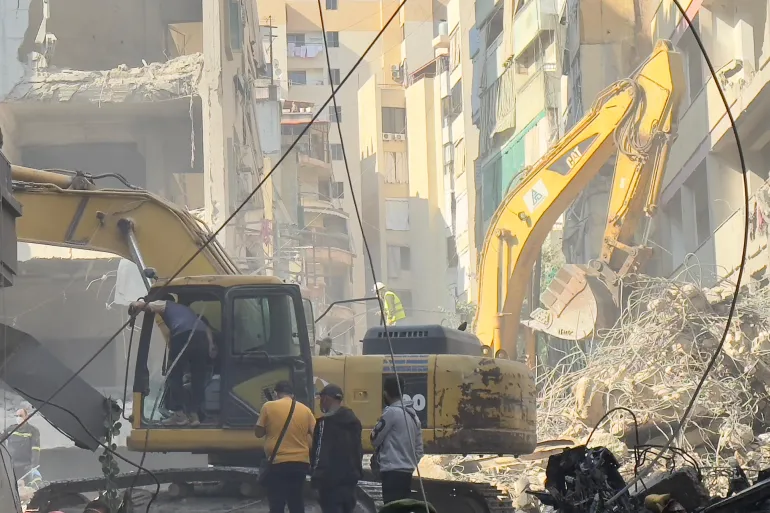
صورة من الدمار في منطقة البسطة أمس
“Masdar Diplomacy” –
By Marlene Khalife
Lebanon witnessed yesterday what has come to be known as “Bloody Wednesday,” marked by the most intense and widespread Israeli airstrikes since the outbreak of hostilities with Hezbollah on March 2. The escalation, described as a “major massacre,” has reshuffled regional and international diplomatic calculations. While attention had been focused on a presumed two-week de-escalation agreement between Tehran and Washington, the Israeli strikes have pushed that understanding to the brink of collapse, amid sharp اختلافات over whether Lebanon was included in the arrangement.
The Wednesday Massacre: “Ten Minutes of Hell”
The Israeli army carried out what it described as its largest coordinated aerial operation, targeting more than 100 command centers and military sites it claimed belonged to Hezbollah in Beirut, the Bekaa Valley, and southern Lebanon—all within just ten minutes. However, sources with close knowledge of field dynamics told “Masdar Diplomacy ” that the strikes hit civilian targets exclusively, without prior warning, in what they described as an attempt to terrorize the population.
Lebanon’s General Directorate of Civil Defense reported a devastating toll: 254 people killed and more than 1,100 wounded. Beirut alone accounted for 91 fatalities, as residential buildings were destroyed over the heads of their inhabitants.
This escalation prompted the United Nations High Commissioner for Human Rights, Volker Türk, to describe the scale of the killings as “horrifying,” calling it “unbelievable” that such a massacre occurred just hours after talk of a ceasefire.
Conflicting Narratives Over the “Truce”
Confusion has surrounded the substance of the reported truce between the United States and Iran, allegedly mediated by Pakistan. Iranian President Masoud Pezeshkian stated that a ceasefire in Lebanon was a fundamental condition for any agreement with Washington, adding that Iran had officially informed Hezbollah that Lebanon was included in the deal.
However, Israeli and U.S. (Republican) responses sharply contradicted this position. Israeli Prime Minister Benjamin Netanyahu declared in a televised address that “Lebanon is not a party to the ceasefire.” This was echoed by U.S. Vice President J.D. Vance and White House spokesperson Karoline Leavitt, with Vance asserting that the Iranians had “misunderstood” the terms and confirming that the truce does not extend to the Lebanese front.
Rumors of an Alleged “Coup” in Lebanon
Simultaneously with the strikes, social media platforms—particularly X (formerly Twitter)—were flooded with claims by activists alleging that Hezbollah was preparing a “military coup” against the Lebanese government in response to international pressure.
Yet thorough investigations into these claims revealed them to be unfounded. Well-informed sources familiar with Hezbollah’s internal climate told “Diplomatic Source” that such reports are entirely false.
They emphasized that these rumors fall within the scope of “psychological warfare,” aimed at justifying the intense Israeli targeting and inciting domestic tensions in Lebanon. The sources stressed that Hezbollah’s focus remains on the military front against Israel, and that coordination with Lebanese state institutions continues through established channels despite the crisis.
The Iranian Equation: Lebanon in Exchange for Hormuz
Behind the scenes of diplomatic contacts, a clear Iranian message has emerged, conveyed both to Hezbollah and to international actors: the next 24 hours will be decisive in determining the fate of the agreement. Either a ceasefire takes hold and opens the door to broader de-escalation, or it collapses, paving the way for unprecedented escalation.
Iran’s strategic reading extends beyond Lebanon’s geography. Tehran considers that “Lebanon is the key to opening the Strait of Hormuz.” According to sources, Iran has indirectly linked the stability of navigation through this vital waterway to halting the aggression against Lebanon. Should Israel continue to exclude Lebanon from any agreement, Iran’s response may extend beyond conventional arenas to threaten critical maritime routes—making “ending the war on Lebanon” the sole trade-off to ensure the continued global flow of energy through Hormuz.
Isolation of the South and Humanitarian Fallout
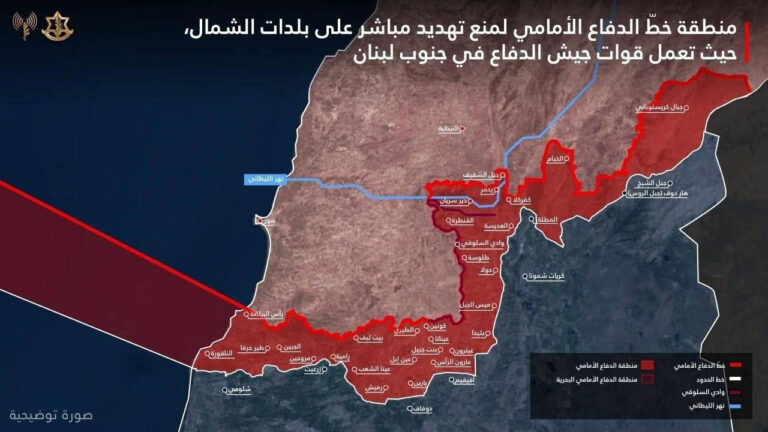
On the ground, the Israeli army destroyed the last bridge connecting southern Lebanon to the rest of the country over the Litani River, effectively isolating the region. Israeli military spokesperson Avichay Adraee announced that the area south of the Litani had become “cut off,” amid Israeli efforts to impose a “buffer zone” and occupy Lebanese territory.
This has led to the displacement of more than 1.2 million people, now living under catastrophic humanitarian conditions.