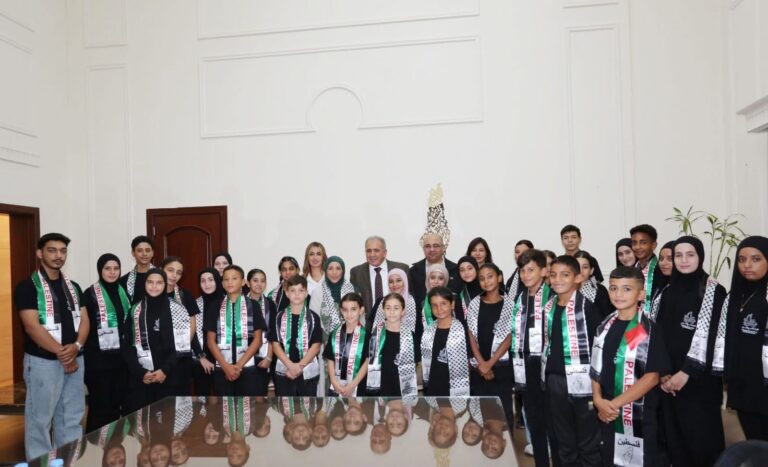

آخر صورة لإعلاميين من قناة المنار قبل تدميرها أمس
Masdar Diplomacy
By Marlene Khalife
The rockets launched last Monday toward Israel and claimed in an official statement by Hezbollah constitute an explicit field declaration of the end of what had been described as a “ceasefire” — a period that, for 15 months, saw what the party characterizes as full Israeli violations of Lebanese sovereignty through assassinations, the destruction of villages, and the obstruction of reconstruction amid governmental silence.
According to well-informed sources familiar with Hezbollah’s internal climate who spoke to Diplomatic Source, the operation upended the status quo, triggered renewed displacement in Israel’s north, and intensified pressure on the decision-making center in “Gush Dan.” This unfolded in parallel with what were described as strategic Iranian strikes targeting U.S. bases and vital facilities in the region, placing the Israeli army under sustained strain and compelling it into a state of maximum alert along the Lebanese border.
These sources argue that the emerging military dynamics are reshaping the terms of any forthcoming negotiations, grounded in what they call “balance-breaking defensive capabilities” that became evident in the downing of U.S. aircraft over Gulf waters and in the escalating tempo of operations demonstrating that the “axis” retains both endurance and calibrated discipline in confronting what it sees as an aggression extending beyond traditional conflict boundaries toward a comprehensive regional confrontation.
In a deeper reading of this military engagement, Hezbollah’s rationale is portrayed as extending beyond conventional “support” for another front. Rather, it is framed as acting “in reliance” on a major regional power — Iran — which, the same sources contend, absorbed enemy strikes and broadened the scope of retaliation to encompass arenas and interests allied with Washington, thereby signaling what they describe as a fundamental shift in the balance of power.
From this perspective, Israeli deterrence — which, in their view, failed to decisively conclude the Gaza war after two years — would not withstand a front under an Iranian umbrella. Hence, Hezbollah’s determination to entrench what it calls an “existential deterrence equation,” rejecting what it sees as the Lebanese authorities’ rush to label the resistance as acting outside the law — a stance the party’s circles describe as paradoxical, given what they characterize as hundreds of days of Israeli destruction.
The same sources assert that a return to pre-confrontation balances is now a matter of the past, ushering in a new political reality that rejects what they describe as surrender and submission — an approach they argue the state seeks to impose by stripping the resistance of its decision-making autonomy and transferring it to an international negotiating framework that has, in their assessment, failed to protect Lebanon’s sovereignty.
Severing the Link with Speaker Nabih Berri
Hezbollah’s entry into what it views as an Iranian–American–Israeli confrontation is seen by the party as outlining a new political and military map that overrides the provisions of the November 27, 2024 agreement. That accord, born under direct pressure from Parliament Speaker Nabih Berri, was at the time regarded by Hezbollah as a constraint on its military arm, preventing it from expanding its strikes on Tel Aviv — which had been targeted, according to these accounts, at Berri’s request for negotiating leverage.
Today, the equation in Haret Hreik is described as no longer one of mere “support” but of full alignment with an open Iranian confrontation that has reshuffled international cards. Hezbollah, according to these sources, seeks to position itself as an integral and structural component of any forthcoming regional settlement, distancing itself from what it views as the traditional negotiating guardianship long embodied by Berri.
This time, the Speaker is said to have been sidelined from what the party considers sovereign resistance decision-making — a development that reportedly generated quiet discontent within Ain el-Tineh, historically the principal negotiating channel and public interlocutor for Hezbollah, even during the tenure of its former Secretary-General, Hassan Nasrallah.
The field and political move follows what the party describes as 15 months of uninterrupted Israeli violations — air and ground incursions, targeted killings, obstruction of reconstruction and even basic repairs — under what it calls a “mock sovereignty” and a “distorted ceasefire” that Israel allegedly failed to honor. Statements by U.S. Ambassador to Israel Mike Huckabee are cited by these circles as reinforcing their conviction that Israeli ambitions are rooted in an expansionist doctrine independent of Hezbollah’s actions.
Against this backdrop, the strategic decision was made to return to the battlefield — to again displace Israel’s northern population and increase pressure on Gush Dan, in tandem with Iranian strikes that, according to these accounts, have placed Israel’s depth under sustained strain, including what was described as the downing of three U.S. aircraft over Kuwait — an indication, the sources argue, of advanced air-defense capabilities within the “axis.”
Government Statement Sparks Objection
Amid this military escalation, and following the six rockets that signaled what Hezbollah’s circles called the end of an agreement the Lebanese government had failed to implement or compel Israel to honor, the Cabinet issued a statement on Monday categorically rejecting any military operations launched from Lebanese territory outside the framework of state institutions.
The government reaffirmed that the decision of war and peace rests exclusively in its hands, calling for the immediate prohibition of all Hezbollah security and military activities and for the party to place its weapons under state authority, confining its role to political activity within constitutional bounds. It tasked the Lebanese Armed Forces with implementing, firmly and immediately, a plan to consolidate arms north of the Litani River, while urging guarantor states to secure a definitive Israeli commitment to halt attacks.
This stance prompted a sharp response from Mohammad Raad, head of Hezbollah’s Loyalty to the Resistance parliamentary bloc. In a detailed statement, Raad said the party understood the government’s inability to confront what he described as Israeli violations of sovereignty and occupation of land, as well as its right to declare war and peace — yet he questioned the rationale for what he termed “theatrical decisions” targeting Lebanese citizens who reject occupation.
Raad argued that while the government had failed to halt Israel’s daily attacks or leverage its international ties to stop the war, Lebanese citizens were awaiting a decision to prohibit aggression — only to be confronted instead, he said, with a decision prohibiting resistance to aggression. Hezbollah’s response, he added, was a rejection of what he described as a path of submission and the illusion that reconciliation with the enemy would secure peace.
He concluded by urging the government, if unable either to impose peace on Israel or to engage in resistance, to refrain from creating additional internal tensions that could inflame an already volatile situation.
Toward a New Regional Equation
By moving beyond what it considers the “ruse” of traditional negotiations and freeing itself from domestic allied pressures, Hezbollah is sending a clear message: a return to the pre–November 27, 2024 framework is no longer conceivable. Any new agreement, in its view, will be written in the language of force shaped by its rockets and by broader geopolitical shifts driven by Iran’s confrontation with the United States.
The party, according to these readings, is not seeking a temporary calm but rather the consolidation of a new deterrence equation that redefines Lebanon’s place in the regional conflict as an actor that cannot be sidelined. It argues that what Israel destroys in days would have been destroyed in a war of attrition in any case — and that the battlefield has now become the sole authoritative voice, pending the contours of what some describe as a new Middle East in which fragile agreements and diminished sovereignty under persistent Israeli threat have no place.